Conference Theme
SOUTHERN OPPORTUNITIES
How can the Global South seize emerging opportunities to become a more equal partner in global governance and advance peace, prosperity, and security in an increasingly divided world?
At the height of the Cold War, John. F Kennedy famously noted that periods of crisis also carried opportunities for positive change. Within the context of increased factionalism in our own time, JFK’s silver-lining appeal provides a foundation for ameliorating the Global North-South gap. As adherence to multilateralism erodes among Global North member states (e.g., the failure of the Paris Accords and CFE Treaty, disbandment of USAID), an opportunity for the Global South to advance the United Nations’ core mandates of peace, prosperity, and security presents itself, paving the way for a more equal world. CISHMUN IV has carefully curated committee topics to explore opportunities for–and barriers to–the Global South re-emerging as an equal partner on the geopolitical stage.
Blurring the North/South Divide to advance a global society with access to equal opportunities has manifold economic, social, and political benefits for all countries while providing an alternative to the recent trend in interstate wars and intrastate genocides. It also has direct bearing on the future of Vietnam, an upper-middle-income Global South nation-state.
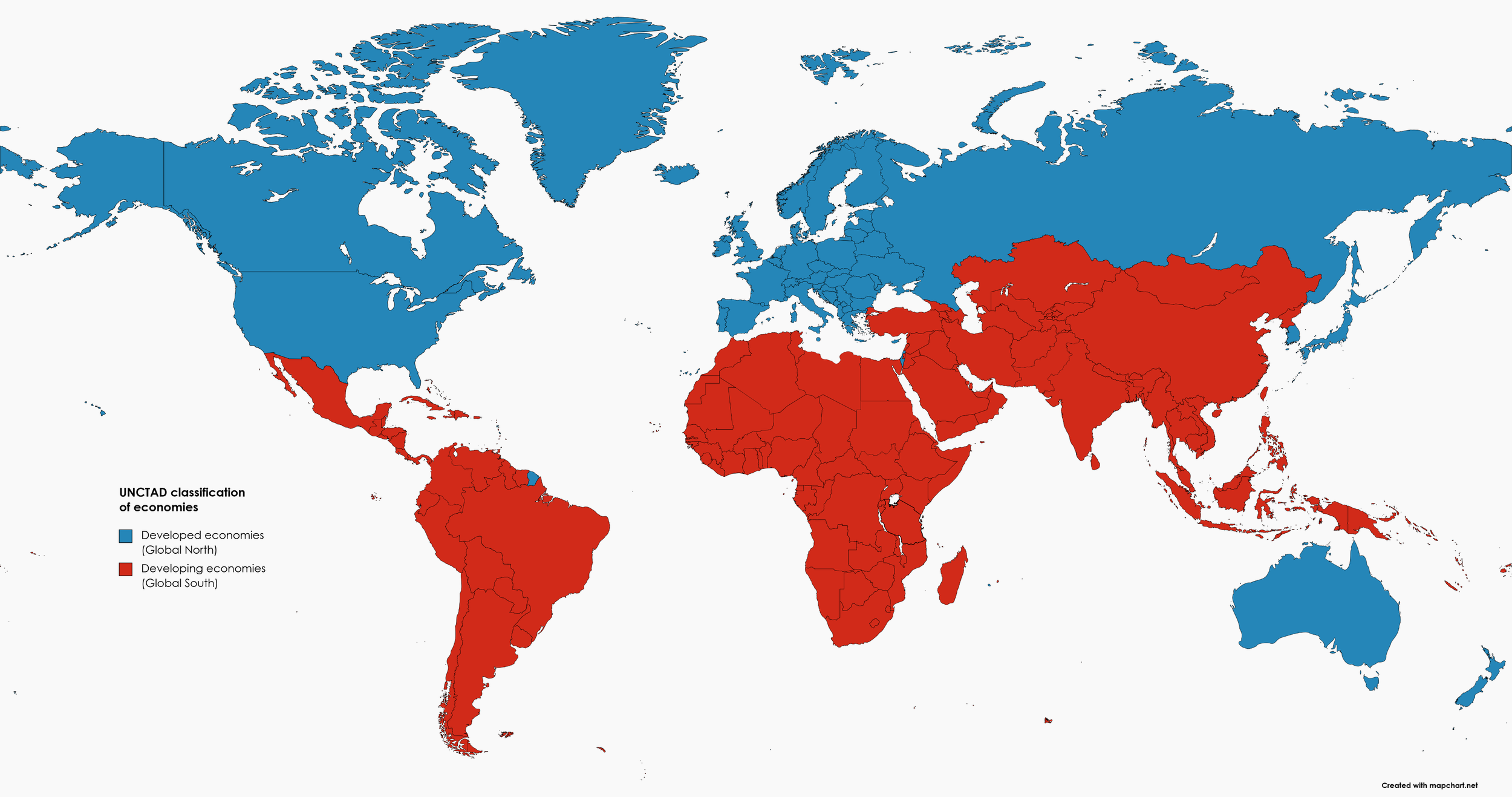
The Brandt Line, shown above, is a visual representation of the global North–South divide, introduced by former West German Chancellor Willy Brandt in the 1980 report North–South: A Programme for Survival, commonly known as the Brandt Report.
Below is the cover of the UNCTAD’s 2018 report, a large inspiration for CISHMUN’s theme. UN Trade and Development’s central purpose is to ensure that trade, investment, finance, and economic development contribute to sustainable and inclusive development with a focus on the Global South.
So, how do we get there?
How do you promote a more egalitarian relationship between the top and bottom halves of the planet without sacrificing sovereignty? We don’t know. That is why we are counting on CISHMUN IV delegates to propose resolutions that map out initiatives for economic growth, peace, sustainability, rule of law, and robust democracies impervious to short-sighted reactionaries. We do, however, recognize that there are compelling big-picture solutions to alleviate the Divide that may interest you, our esteemed delegate. We invite you to investigate our Further Exploration suggestions below to broaden your contextual understanding. We’ve also invited the current Colombian Ambassador to Vietnam, Camila María Polo Flórez, to serve as our keynote speaker, providing insights on this issue with a focus on South-to-South solutions similar to those being explored between Colombia and Vietnam.
Suggested Further Reading
Forging a Path Beyond Borders: The Global South by UNCTAD (2018)
The Fallen of WWII by Neill Halloran to explore how peace and prosperity are increasing in the North and South
The Preamble to the UN Charter to explore the world’s post-imperialist mission to spread equitable peace and prosperity
The Myth of Globalization by Shannon O’Neill hosted by NYU Stern to explore how regionalism may trump globalizations
Willy Brandt’s “Brandt Line” (1980) to explore the geographic demarcation of the Global North and South
Non-Aligned Movement to explore how the Global South (née the Third World) works collaboratively outside of the UN
The World is Flat by Thomas Friedman to explore the growing post-WWII prosperity of (almost all) post-WWII nation-states
Guns, Germs, and Steelby Jarred Diamond to explore how geographic determinism can create barriers for the Global South
Gapminder created by Hans Rosling to explore an easy-to-understand graphic representation of the growing post-WWII prosperity of (almost all) post-WWII nation-states